Watercolor Meadow Seamless Patterns: A Practical Guide for Designers and Crafters
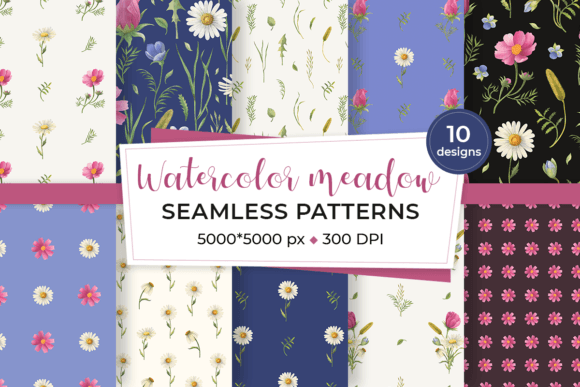
Watercolor Meadow Seamless Patterns is a curated digital collection of 10 hand-painted, botanical-inspired seamless patterns—each featuring wildflowers and herbs rendered in soft, expressive watercolor. Unlike algorithmically generated or vector-based repeats, these patterns are built from original, hand-drawn artwork scanned and digitally refined to preserve texture, pigment variation, and organic flow. The result is a set that feels both authentic and versatile: subtle enough for elegant stationery, rich enough for textile printing, and flexible enough for both screen and print workflows.
What Sets Watercolor Meadow Seamless Patterns Apart
The distinction lies not just in the medium—watercolor—but in how the technique translates into functional design assets. Each pattern was painted by hand, then carefully tiled to eliminate visible seams without compromising natural brushwork or pigment bleed. That means no hard edges, no repetitive pixel-perfect loops, and no loss of translucency or granulation—the very qualities that make real watercolor appealing.
This contrasts with many mass-produced pattern libraries where watercolor textures are applied as overlays onto rigid geometric repeats, or where digital brushes simulate pigment behavior without capturing its unpredictability. Watercolor Meadow Seamless Patterns retains the slight irregularities—the faint blooms, the gentle washes, the uneven drying—that signal human authorship and tactile origin. For designers prioritizing authenticity over uniformity, that difference is tangible in final output, especially at larger scales like wallpaper or fabric yardage.
Format and Technical Considerations
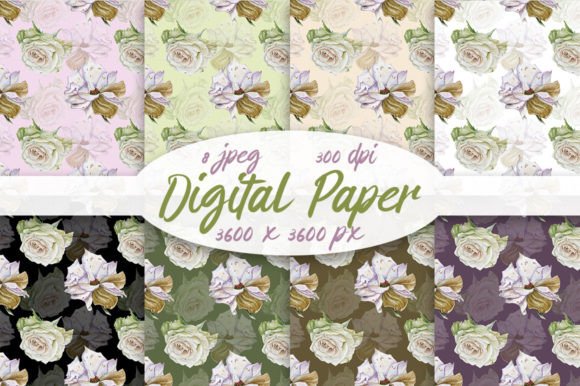
All patterns are delivered as high-resolution PNG files (5000 × 5000 px, 300 DPI, RGB), offered in two background options: solid color and transparent. This dual-format approach supports diverse production needs. The colored-background versions simplify use in tools with limited layer support (e.g., basic Canva templates or some print-on-demand platforms), while the transparent-background files allow precise layering, color adjustments, and integration into complex layouts—ideal for branding projects or multi-element packaging designs.
At 5000 px square, each file scales cleanly up to A2 poster size or down to business card resolution without interpolation artifacts. That resolution also accommodates embroidery digitizing prep or sublimation printing on apparel—though users should verify color profiles and bleed requirements with their specific printer or manufacturer, since RGB on screen may shift slightly in CMYK or dye-sublimation output.
Real-World Use Cases and Fit
Watercolor Meadow Seamless Patterns excels where warmth, subtlety, and botanical character matter. It’s frequently chosen for:
- Greeting cards and invitations — where soft floral motifs complement handwritten fonts and minimalist typography without overwhelming;
- Planner covers and journal interiors — where repeated texture adds visual interest without distracting from written content;
- Small-batch textile printing — especially for scarves, tea towels, or tote bags where watercolor’s gentle contrast reads well on natural fibers like cotton or linen;
- Packaging for wellness, herbal, or artisanal food brands — where the wildflower-and-herb motif reinforces themes of natural ingredients and handmade care.
It’s less suited for applications demanding bold contrast, sharp geometry, or maximalist density—think tech branding, athletic apparel, or children’s educational materials where clarity and scalability at tiny sizes take priority. In those cases, bolder vector-based florals or stylized linocut patterns may offer better legibility and reproduction fidelity.
Comparing Approaches: Hand-Painted vs. Digital-First Patterns
Many designers weigh hand-painted resources like Watercolor Meadow Seamless Patterns against alternatives: generative AI tools, subscription-based pattern libraries, or custom commission work. Each has tradeoffs.
AI-generated patterns can produce endless variations quickly—and often at low cost—but rarely replicate the nuanced layering, pigment interaction, or intentional imperfection of real watercolor. They tend to homogenize texture, flatten depth, and struggle with true seamlessness without manual correction. Watercolor Meadow Seamless Patterns avoids that compromise: it offers consistency *and* character, without requiring post-processing to “humanize” the output.
Subscription services provide volume and variety but often lack cohesive aesthetic direction. A single collection like Watercolor Meadow Seamless Patterns gives designers a unified palette—same paper grain, same pigment saturation range, same botanical vocabulary—making it easier to maintain visual continuity across multiple projects (e.g., matching wedding stationery with a coordinating planner and gift tags).
Custom commissions offer full control over species, color, scale, and repeat dimensions—but at higher cost and longer lead times. Watercolor Meadow Seamless Patterns delivers professional-grade results immediately, with no back-and-forth or revision cycles. That makes it practical for time-sensitive launches, seasonal collections, or designers building a personal library across years rather than individual jobs.
Limitations to Acknowledge
Because these are watercolor-based, color flexibility is constrained by the original painting. While the transparent-background files allow hue shifts in editing software, drastic recoloring (e.g., turning a soft sage palette into neon pink) can mute texture or introduce banding. Subtle tonal adjustments—lightening, desaturating, or shifting toward analogous hues—preserve integrity best.
The collection focuses exclusively on wildflowers and herbs—not tropical blooms, cultivated roses, or abstracted florals. If your project calls for peonies, orchids, or desert flora, this set won’t expand your botanical range. Likewise, it contains no borders, frames, or isolated elements—just seamless repeats. Users needing standalone motifs for logo development or icon sets would need to supplement with additional resources.
Making the Right Choice for Your Project
Watercolor Meadow Seamless Patterns is strongest when you value:
- Authentic texture over synthetic polish — if your brand voice leans toward craft, sustainability, or quiet luxury;
- Immediate usability — if you’re balancing multiple deadlines and need reliable, print-ready assets without setup time;
- Cohesion across outputs — if you’re designing coordinated product lines (e.g., a candle brand’s labels, boxes, and social media banners);
- Medium-agnostic flexibility — if your workflow spans print, web, and physical goods, and you prefer working in RGB before converting as needed.
It’s less optimal if you require CMYK-optimized files out of the box, need Pantone-matched swatches, or work primarily in vector environments where raster-based patterns introduce scaling constraints. In those cases, pairing this set with a vector-compatible botanical resource—or opting for a hybrid library that includes both formats—may better serve long-term needs.
Final Notes on Integration and Workflow
Because the files are high-res PNGs, they integrate smoothly into Adobe Creative Suite, Affinity apps, Procreate (with proper canvas sizing), and most modern design tools. For textile designers, the 5000 px dimension aligns well with standard repeat tile recommendations for digital fabric printing services (e.g., Spoonflower, Contrado). For planners or diaries, the transparency option allows easy overlay on grid or dot patterns without clipping or masking steps.
As with any digital paper, testing a small print sample—especially on your intended substrate—is advisable. Paper stock, ink type, and coating all affect how watercolor textures render. What reads as delicate on matte uncoated stock may appear muted on glossy finishes; similarly, fabric dye absorption can soften edges further. Keeping that variability in mind helps manage expectations and refine selections early.
Watercolor Meadow Seamless Patterns doesn’t replace technical precision—it complements it. It brings breath, variation, and quiet intention to designs that might otherwise feel overly engineered. When used thoughtfully, it supports storytelling through material language: the kind of detail that invites pause, implies care, and quietly signals quality.