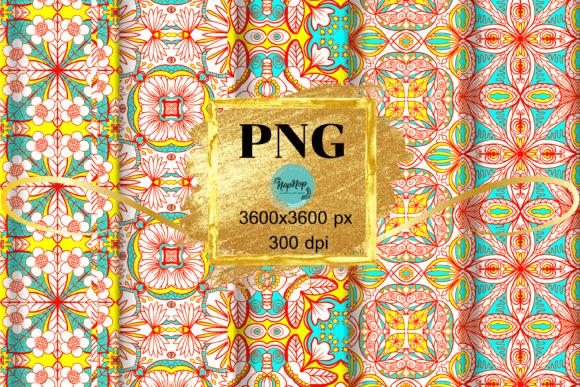
Mandala Patterns Beauty Vector: A Versatile Design Resource for Creative Professionals and Educators
Mandala Patterns Beauty Vector is more than a decorative asset—it’s a thoughtfully engineered design resource built for adaptability, precision, and cross-disciplinary utility. Unlike generic clipart or low-resolution stock graphics, this collection delivers six high-fidelity digital files optimized for both digital display and scalable production. Each file maintains crisp integrity whether viewed on a mobile screen, printed on fabric, laser-cut into wood, or layered into an interactive learning module. Its 1920px × 1280px canvas size strikes a practical balance: large enough to support detailed inspection and editing, yet manageable for everyday workflows across platforms and devices.
Why File Format Diversity Matters in Real-World Projects
The inclusion of one AI (Adobe Illustrator), one EPS, one SVG, one DXF, one JPG, and one PNG file isn’t arbitrary—it reflects deliberate consideration for how different users interact with visual assets. Designers preparing branding materials benefit from the vector scalability and layer fidelity of the AI and EPS files. Educators building classroom presentations or printable worksheets rely on the universally supported JPG and PNG for quick integration into slides, LMS platforms, or handouts. Meanwhile, makers, crafters, and small-batch producers use the SVG and DXF formats to drive cutting machines—whether operating a Cricut, Silhouette Cameo, or industrial CNC router.
For example, a textile designer developing a limited-run scarf collection can import the SVG into a pattern-making suite, adjust stroke weights for screen printing, and export color-separated layers without pixelation. A university art instructor might embed the PNG into a Canvas assignment prompt, then ask students to analyze symmetry, radial balance, and cultural motifs embedded in the mandala structure—using the same file that a graphic designer later adapts into a responsive website background via CSS background-image rules.
Technical Flexibility Without Compromise
Each format serves a distinct technical role while preserving core design integrity:
- AI File: Full editable layers, paths, and swatches—ideal for modifying colors, isolating elements, or integrating with other Adobe Creative Cloud projects.
- EPS File: Legacy compatibility with older vector software and print service providers; retains resolution independence and supports CMYK color profiles.
- SVG File: Web-native, lightweight, and scriptable—enables dynamic interaction (e.g., hover effects, animation via CSS or JavaScript) and responsive sizing across viewport widths.
- DXF File: Industry-standard for CAD and CAM workflows; translates vector geometry accurately into machine toolpaths for precise physical reproduction.
- JPG File: Optimized for fast loading and broad compatibility—useful for email newsletters, social media posts, or internal documentation where editing isn’t required.
- PNG File: Preserves transparency and sharp edges—essential when overlaying the mandala onto photos, gradients, or textured backgrounds without visible halos or fringing.
This multi-format approach eliminates the need for time-consuming conversions or quality loss from repeated resampling. It also reduces friction between teams—for instance, when a marketing specialist shares the PNG with a copywriter, while the production manager uses the DXF to program a vinyl cutter for event signage.
Applications Across Disciplines and Scales
Mandala Patterns Beauty Vector finds resonance far beyond aesthetic decoration. Its symmetrical, concentric structure lends itself to pedagogical clarity, therapeutic engagement, and functional design systems.
In education, mandalas serve as tactile entry points for teaching geometry concepts—rotational symmetry, tessellation, proportion, and degrees of arc. A middle school math teacher might project the SVG onto an interactive whiteboard, then use annotation tools to highlight repeating units or measure angular intervals between petals. In psychology or wellness courses, students explore the historical and cross-cultural significance of mandalas in meditation, ritual, and cognitive grounding—using the vector file as a visual anchor during reflective exercises.
For healthcare and wellness professionals, the pattern supports visual therapy tools. Occupational therapists print high-resolution versions on heavy cardstock for fine-motor tracing activities. Counselors incorporate the design into guided visualization scripts, referencing its center-to-periphery flow as a metaphor for self-regulation or emotional expansion. Because the files are editable, clinicians can simplify or enrich complexity—removing intricate linework for younger clients or adding labeled zones for mindfulness prompts.
Small business owners leverage Mandala Patterns Beauty Vector to unify brand expression economically. A yoga studio uses the SVG to generate custom watermarks for class recordings, applies the AI file to create embroidered patches for staff apparel, and exports the DXF for etching onto wooden welcome signs. The consistency across touchpoints reinforces identity without requiring custom illustration commissions.
Design Integrity Meets Cultural Sensitivity
A well-crafted mandala balances mathematical rigor with symbolic resonance—and Mandala Patterns Beauty Vector honors that duality. Its construction avoids appropriation by prioritizing universal geometric language over culturally specific iconography (e.g., no deities, mantras, or region-locked motifs). This makes it appropriate for secular, interfaith, or international contexts—from corporate wellness initiatives in Singapore to public library programming in Toronto.
Still, users benefit from awareness: while the vector itself is neutral, application matters. Overlaying text in Sanskrit without context—or using the pattern as a superficial “spiritual” backdrop for commercial products—risks misrepresentation. Thoughtful implementation includes citing sources where relevant, consulting cultural advisors for community-facing work, and allowing space for interpretation rather than prescribing meaning.
Workflow Integration and Practical Editing Tips
Editing Mandala Patterns Beauty Vector requires no specialized expertise—but understanding basic vector principles unlocks greater control. In Illustrator, ungrouping layers reveals individual petal groups, central motifs, and border elements. Adjusting the stroke width of a single path affects only that element, enabling selective emphasis (e.g., thickening outer rings for contrast against light backgrounds). Color changes apply instantly across all instances if swatches are used—streamlining brand alignment across multiple deliverables.
For non-designers, free tools like Inkscape (open-source) or Figma (browser-based) open the SVG and EPS files with full editability. Even basic adjustments—repositioning the mandala within the canvas, cropping to focus on a quadrant, or converting strokes to outlines for consistent rendering—require under two minutes. The JPG and PNG files, meanwhile, integrate seamlessly into Canva, Google Slides, or Microsoft PowerPoint for rapid prototyping.
One underutilized strength is modular reuse. Rather than treating the mandala as a monolithic image, users extract components: a single petal becomes a bullet point icon; concentric circles transform into progress trackers; the central dot anchors infographics. This compositional flexibility extends lifespan and ROI—turning one purchase into dozens of contextual applications.
Long-Term Value Beyond Immediate Use
Unlike transient trends, mandala-based design endures because it aligns with fundamental human preferences: symmetry signals order and safety; repetition supports pattern recognition and memory encoding; radial layouts mirror natural phenomena (flowers, galaxies, ripples)—making them intuitively legible across age and culture.
Mandala Patterns Beauty Vector anticipates evolving needs. As accessibility standards tighten, its clean vector paths ensure compatibility with screen readers when paired with proper ARIA labels in web implementations. As sustainability becomes central to design ethics, its reusability reduces reliance on disposable visual assets—supporting circular creative practices.
Moreover, its fixed 1920×1280 dimensions provide predictable scaling behavior. Whether scaled down to 400×267px for a mobile app icon or enlarged to 6000×4000px for a mural, proportions remain intact. No interpolation artifacts, no fuzzy edges—just reliable geometry ready for whatever comes next.
Ultimately, Mandala Patterns Beauty Vector functions less like a static download and more like a foundational element—a shared visual vocabulary that designers, educators, makers, and communicators can adapt, annotate, and evolve without losing coherence or quality. Its value isn’t measured solely in pixels or formats, but in how effortlessly it moves between intention and execution—across disciplines, devices, and decades.