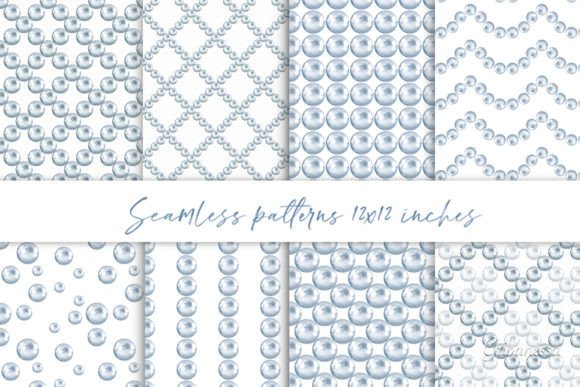
Pearls. Seamless Patterns: A Versatile Resource for Creative Professionals and Makers
Seamless patterns built around the timeless visual language of pearls offer more than decorative appeal—they provide a bridge between classical elegance and contemporary design flexibility. Pearls. Seamless Patterns is a curated digital asset collection designed not as static ornamentation, but as a functional, scalable foundation for diverse creative workflows. Comprising eight high-fidelity JPG files—each precisely 3600×3600 pixels at 300 dpi—the set delivers technical precision alongside aesthetic cohesion. Its seamless tiling behavior ensures continuity across any surface size, eliminating visible edges or breaks during repetition—a critical requirement for professional-grade output in both physical and digital media.
Why Seamless Pearl Motifs Matter Beyond Aesthetics
At first glance, pearl-based patterns evoke luxury, refinement, and organic symmetry. But their practical value lies deeper—in structural consistency and perceptual harmony. Unlike irregular or overly complex motifs, pearl arrangements lend themselves naturally to mathematical tiling: their rounded forms distribute visual weight evenly, support predictable repeat offsets, and maintain legibility even when scaled down to 12-point print or enlarged to mural proportions. This predictability translates directly into time savings during layout, fewer revisions in prepress, and greater confidence when applying patterns to curved or irregular substrates like fabric rolls, cylindrical gift boxes, or textured wall panels.
Consider a wedding stationery designer preparing invitation suites. Using a non-seamless pattern risks misaligned repeats along folded edges or bleed zones—resulting in costly reprints. With Pearls. Seamless Patterns, the same tile can extend fluidly across an A7 envelope, a belly band, and a foil-stamped thank-you card without manual intervention. Similarly, an educator developing tactile learning materials for sensory integration activities can scale the pattern to fit laminated flashcards, then seamlessly repeat it across a classroom bulletin board—all while preserving fine detail necessary for visual discrimination exercises.
Technical Specifications Designed for Real-World Output
The eight included JPG files are not variations on a single theme, but distinct compositional interpretations—each optimized for specific applications:
- Subtle Gradient Pearl Field: Low-contrast tonal shifts ideal for backgrounds in digital presentations or printed reports where readability must remain uncompromised.
- Tight Clustered Arrangement: High-density placement suited for fabric printing, especially on lightweight silks or cotton voiles where motif clarity affects drape perception.
- Asymmetrical Drift Pattern: Introduces gentle directional flow—valuable for packaging design where visual hierarchy guides the consumer’s eye toward product information or branding elements.
- Monochrome Luster Variation: Three grayscale options (cool, neutral, warm undertones) enable precise color matching without requiring additional color correction layers in post-production.
- Micro-Pearl Texture Overlay: Fine-grained repetition functions effectively as a subtle noise layer in digital illustration or photo compositing, adding tactile authenticity without overwhelming foreground content.
- Spaced Linear String Motif: Mimics draped pearl strands; works exceptionally well for borders on certificates, diplomas, or archival-quality scrapbook pages.
- Organic Scatter with Negative Space: Prioritizes breathing room—ideal for children’s activity sheets, educational posters, or minimalist greeting cards where whitespace supports cognitive processing.
- Geometric Interlock Variant: Integrates pearlescent shapes within clean angular frameworks, supporting brand identities that balance tradition with modernity (e.g., heritage skincare labels or boutique architecture firm proposals).
All files adhere to industry-standard CMYK-ready color profiles and embed ICC metadata, ensuring fidelity across devices—from calibrated studio monitors to commercial offset presses. The 3600×3600px resolution allows for crisp reproduction at up to 12×12 inches at 300 dpi, covering standard poster sizes, fabric swatch books, and large-format invitations without interpolation artifacts.
Application Spectrum Across Disciplines
The versatility of Pearls. Seamless Patterns emerges most clearly when viewed through the lens of cross-sector usage—not as isolated examples, but as interconnected practices sharing underlying technical needs.
For paper crafters and scrapbook artists, the patterns serve dual roles: as printable base layers for mixed-media collage and as cuttable templates for embossing or die-cutting. Because each file maintains edge-to-edge continuity, a single tile can be imported into cutting software (like Cricut Design Space or Silhouette Studio), repeated across a mat, and sliced into identical pearl-shaped embellishments—ensuring uniformity across dozens of handmade cards or journal covers.
In textile and surface design, the absence of hard seams prevents “ghost lines” during rotary screen printing or sublimation transfers onto polyester blends. A fashion student prototyping a capsule collection can test how the Tight Clustered Arrangement behaves on stretch-knit versus structured wool crepe—observing how fiber texture interacts with motif scale without altering the source file.
Educators and curriculum developers leverage these patterns in inclusive design contexts. For learners with visual processing differences, the consistent rhythm of pearl repetition supports visual tracking during reading tasks. Meanwhile, occupational therapists incorporate printed versions into fine motor skill kits—using the Spaced Linear String Motif as a tracing guide for pencil control, or laminating the Micro-Pearl Texture for tactile discrimination exercises.
Small business owners benefit from scalability in branding collateral. A local artisanal soap maker might use the Monochrome Luster Variation as a watermark on product photography, then apply the Organic Scatter version to custom tissue paper—creating cohesive unboxing experiences without commissioning bespoke illustrations. No licensing restrictions apply to derivative physical products, enabling commercial reuse across unlimited SKUs.
Integration Into Existing Workflows
Adopting Pearls. Seamless Patterns requires no specialized software or training. Each JPG imports natively into Adobe Creative Cloud applications, Affinity Suite, Canva Pro, and open-source tools like GIMP or Inkscape (via raster import). For vector-based projects, designers can place the JPG as a linked image, trace key contours using auto-trace functions, and convert to editable paths—retaining the original’s proportionality while gaining full typographic or dimensional control.
In collaborative environments, the files function reliably within shared cloud libraries. Teams using Figma or Adobe XD can upload them as local assets for UI mockups—applying the Gradient Pearl Field as a soft background for dashboard cards or modal windows where visual calm enhances data comprehension. Print service providers accept the files directly; no flattening, embedding, or conversion is needed—reducing preflight errors and accelerating turnaround times.
Importantly, the patterns avoid overused tropes: no clichéd “nautical rope + pearl” hybrids, no excessive metallic shimmer that fails under fluorescent lighting, and no reliance on trendy gradients that date quickly. Instead, they emphasize enduring composition principles—balance, rhythm, contrast, and scale—that remain effective regardless of shifting stylistic currents.
Thoughtful Considerations for Responsible Use
While technically robust, effective application depends on contextual awareness. Designers should assess substrate interaction: glossy papers enhance luster but may mute subtlety; matte finishes soften contrast but improve readability in ambient light. When used for fabric, test prints on actual yardage—especially with reactive dyes—since pigment absorption alters perceived warmth and depth.
Accessibility also warrants attention. Though inherently elegant, high-contrast pearl patterns (e.g., stark black-on-white variants) may pose challenges for users with photosensitive epilepsy or vestibular processing sensitivities if animated or rapidly scrolled. Static applications remain fully compliant with WCAG 2.1 guidelines when paired with appropriate text contrast ratios.
Finally, sustainability intersects with digital asset use. By providing production-ready files that eliminate the need for redundant rendering or multiple export iterations, Pearls. Seamless Patterns reduces computational energy consumption per project—an often-overlooked factor in eco-conscious creative practice.
Conclusion: Patterns as Infrastructure, Not Decoration
Pearls have symbolized wisdom, integrity, and transformation across cultures for millennia. Translated into seamless digital form, they evolve beyond metaphor into practical infrastructure—supporting clarity in communication, efficiency in production, and intentionality in expression. Whether anchoring a doctoral thesis cover, wrapping a handmade ceramic vase, illustrating a children’s book about ocean ecosystems, or forming the repeating motif on a museum exhibition banner, these patterns operate with quiet reliability. They do not demand attention; they enable it. And in doing so, they honor the quiet craftsmanship embedded in both the natural pearl and the thoughtful human hand that places it—repeatedly, respectfully, and with purpose.