Patterns Roses Digital Paper, JPEG: A Practical Guide for Designers and Crafters
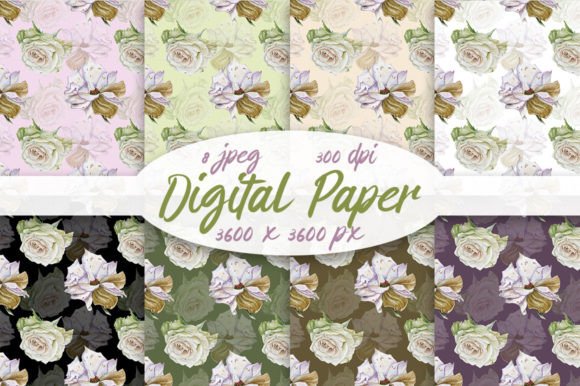
Patterns Roses Digital Paper, JPEG is a curated set of eight high-resolution, seamless digital papers featuring rose-inspired motifs. Each file is delivered in JPEG format at 3600×3600 pixels and 300 DPI—optimized for print and versatile enough for digital use. Unlike vector-based or layered PSD files, this collection prioritizes immediate usability: no editing software required beyond basic image handling, no transparency concerns, and no learning curve to unlock the pattern.
What Sets This Collection Apart
The distinction lies in its focused execution—not breadth, but consistency. Many digital paper bundles mix florals, geometrics, textures, and abstracts across dozens of files. Patterns Roses Digital Paper, JPEG narrows scope deliberately: every pattern centers on roses, rendered with cohesive line weight, spacing, and tonal balance. That consistency supports unified branding or themed projects without visual fatigue or mismatched scales.
Seamless tiling is built-in—not approximated. Each tile edge aligns precisely so that when repeated across a surface (a greeting card background, fabric mockup, or scrapbook page), no visible seams or misaligned stems disrupt the flow. This matters especially for large-format outputs like posters or wall decals, where subtle misalignment becomes glaring at scale.
The JPEG format introduces both advantages and constraints. It’s universally compatible—openable in Preview, Paint, Canva, Affinity Designer, and even email clients—and requires no licensing for commercial use within standard terms. However, because JPEGs are raster-based and flattened, users cannot recolor individual elements, adjust rose density independently, or isolate petals for custom compositing. That tradeoff favors speed over flexibility.
How It Compares Across Common Alternatives
Designers evaluating digital papers often weigh four practical dimensions: resolution and scalability, editability, color control, and licensing clarity. Here’s how Patterns Roses Digital Paper, JPEG fits into that landscape:
- Vector patterns (e.g., AI or SVG files): Offer infinite scalability and full recoloring via swatches or path selection—but require vector-capable software and more technical familiarity. If your workflow relies heavily on Adobe Illustrator or Figma for precise adjustments, a vector rose pattern may suit long-term customization better.
- PSD files with layers: Provide transparency, blend modes, and editable elements (e.g., rose layer vs. background texture). Ideal for complex composites or designers who routinely tweak contrast, hue, or opacity per element. But they’re larger in file size, less portable, and not all platforms support layered imports natively.
- Low-res or web-optimized PNGs: Often free or inexpensive, but rarely exceed 2400×2400 pixels or 72 DPI. They work well for social media graphics or web banners but risk pixelation when printed at 5×7 inches or larger—making them unsuitable for professional stationery or packaging.
- Subscription-based pattern libraries: Give access to hundreds of designs across categories, updated regularly. Useful if you need variety across seasons or themes—but less efficient if you only require rose motifs for a specific campaign or product line. Subscriptions also introduce recurring cost and potential licensing ambiguity across usage tiers.
Realistic Use Cases Where It Excels
Patterns Roses Digital Paper, JPEG shines in scenarios where consistency, print readiness, and simplicity outweigh the need for granular editing. Consider these examples:
- A small-batch stationery maker producing wedding invitations: They can apply one pattern as a full-page background in Canva or InDesign, confident it will tile cleanly across folded cards and envelopes—no extra testing for seam alignment needed.
- An Etsy seller designing printable art: The 3600×3600 size allows crisp output up to 12×12 inches at 300 DPI, supporting framed prints, planners, or digital stickers without upscaling artifacts.
- A teacher creating themed classroom resources: A single rose pattern can unify worksheets, certificates, and bulletin board headers—no need to manage multiple color variants or file types across grade levels.
- A self-publishing author formatting an interior for a romance novel: Using one of the eight patterns as a chapter divider background adds visual rhythm without distracting from text—especially when applied at 15–20% opacity in layout software.
Key Limitations to Acknowledge
No digital resource fits every need—and recognizing boundaries helps avoid frustration later. With Patterns Roses Digital Paper, JPEG, three limitations bear mentioning:
- No transparency: Because JPEG doesn’t support alpha channels, overlays (e.g., placing text directly over the pattern without a white box) require either careful contrast planning or additional masking steps in editing tools.
- Fixed color palettes: Each of the eight patterns ships with its own preselected rose-and-background combination. While harmonious, they don’t allow real-time hue shifts or saturation tweaks without external tools—meaning if your brand uses a specific Pantone red, manual color correction may be necessary.
- Monitor-dependent appearance: As noted in the product details, colors may vary slightly across devices. A warm-toned rose on a MacBook Pro might appear cooler on a calibrated EIZO monitor or a budget Windows laptop. For critical color matching (e.g., coordinating with physical ink or fabric swatches), soft-proofing against a known CMYK profile or ordering a test print is advisable.
When to Choose It—and When to Look Elsewhere
This collection is most appropriate when your priority is reliability over experimentation. If you’ve already settled on a rose motif, need print-ready assets quickly, and plan to use them across multiple static layouts (invitations, labels, digital downloads), Patterns Roses Digital Paper, JPEG reduces decision fatigue and technical overhead.
Conversely, consider alternatives if any of the following apply:
- You need to match a specific brand color exactly—and lack time or tools to adjust hues post-download.
- Your project involves animation, interactive PDFs, or responsive web design where scalable vectors or SVGs would perform more efficiently.
- You anticipate frequent reuse across varied themes (e.g., switching from roses to peonies or botanical line art mid-project) and value diversity over motif consistency.
- You’re working under tight commercial license restrictions and need explicit written confirmation of usage rights beyond standard terms—some vendors provide extended licenses for resale items like physical planners; verify whether this collection includes those options.
Making a Grounded Decision
Evaluating digital papers isn’t about finding the “best” option—it’s about matching capability to intention. Patterns Roses Digital Paper, JPEG delivers what it promises: eight polished, seamless, high-resolution rose patterns, ready for immediate integration. Its strength is in constraint: by limiting scope to one motif and one format, it avoids bloat and maintains quality control across all files.
Before purchasing, ask yourself two questions: First, will I use all—or at least most—of these eight variations? Second, does my current toolset and timeline benefit more from plug-and-play JPEGs or editable, adaptable formats? There’s no universal answer—but understanding where this collection sits in the broader ecosystem of digital design resources makes the choice clearer, not harder.