Shabby Chic Chintz Floral Patterns: Timeless Texture for Modern Makers
Shabby Chic Chintz Floral Patterns sit at a quiet but powerful intersection of nostalgia and utility—where delicate botanical motifs, soft vintage palettes, and technical precision meet real-world creative needs. Unlike fleeting design fads, this aesthetic endures because it answers practical questions: How do you add warmth to digital work without sacrificing scalability? How do you translate romantic, hand-painted charm into seamless, production-ready assets? And how do you serve both the wedding stationer needing elegant invitation backdrops and the small-batch apparel designer sourcing sublimation-ready fabric repeats?
More Than Just a Pattern—A Workflow Solution
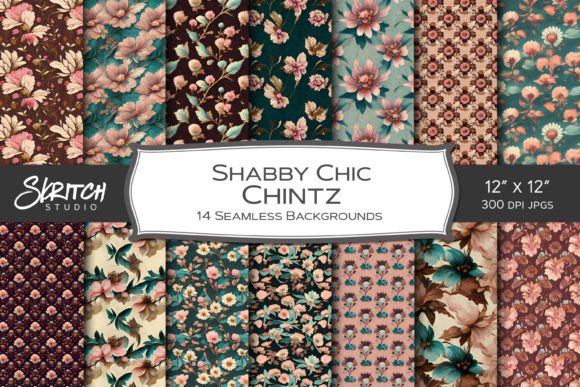
What sets these Shabby Chic Chintz Floral Patterns apart isn’t just their visual character—it’s their engineered functionality. Each of the 12 included designs is delivered as a 3600 × 3600 pixel seamless JPEG, optimized for tiling across large surfaces without visible breaks or distortion. That means no manual cloning in Photoshop to fill a 48-inch-wide fabric panel, no awkward scaling when wrapping a custom gift box, and no pixelation when printing a 24×36” wall art piece. The resolution supports high-fidelity output whether used on matte paper for Mother’s Day scrapbooking ephemera or heat-transferred onto cotton-linen blends for cottagecore-inspired loungewear.
This level of technical readiness reflects a broader shift in creative workflows: professionals and serious hobbyists increasingly expect digital assets to behave like physical materials—predictable, scalable, and production-integrated. Designers no longer want “pretty previews”; they need files that drop into Procreate brushes, layer cleanly in Affinity Publisher for invitation suites, or tile automatically in Cricut Design Space for planner sticker sheets. These patterns deliver exactly that—without requiring additional editing, resampling, or licensing gymnastics.
The Palette That Bridges Eras: Pink, Brown, and Robin’s Egg Blue
The curated colorway—soft pink, warm brown, and robin’s egg blue—isn’t arbitrary. It’s a deliberate bridge between historical chintz traditions and contemporary sensibilities. Traditional chintz, originating in 17th-century India and later adapted by English textile mills, often featured bold reds and indigos. Today’s reinterpretation softens those contrasts while preserving chromatic harmony: the pink evokes dried rose petals rather than candy; the brown reads as antique oak or parchment, not muddy grey; the robin’s egg blue carries the clarity of morning light—not synthetic cyan.
This palette performs exceptionally well across use cases. On wedding invitations, it conveys romance without cliché—ideal for intimate garden ceremonies or vintage-themed receptions. In home decor projects, it grounds airy spaces with subtle richness, especially when layered with natural textures like linen, rattan, or unglazed ceramics. For scrapbooking and junk journaling, the colors reproduce faithfully on consumer-grade inkjet printers and hold up beautifully under mixed-media techniques—collage glue, watercolor washes, or light stamping won’t overwhelm the underlying motif.
Where Tradition Meets Today’s Creative Economy
Shabby Chic Chintz Floral Patterns resonate now because they align with several concurrent cultural and economic currents. First, there’s the rise of “intentional making”—a move away from mass-produced aesthetics toward objects and experiences that feel personally curated. A small business owner launching a line of handmade soy candles doesn’t just need packaging; they need continuity between label design, Instagram story backgrounds, and in-store shelf banners. These patterns offer that cohesion.
Second, cottagecore and slow living aesthetics have moved beyond Pinterest boards into tangible commerce. Etsy sellers report sustained demand for printable wedding suites, printable wall art bundles, and digital scrapbook kits—all categories where seamless, high-res floral repeats are foundational. Likewise, educators creating classroom resources or therapists designing calming journal prompts benefit from gentle, non-distracting backgrounds that support focus rather than compete with content.
Third, print-on-demand (POD) platforms continue lowering barriers to entry for designers. But success on those platforms hinges on asset quality: low-resolution files get flagged for poor print fidelity; non-seamless patterns create costly production delays. These Shabby Chic Chintz Floral Patterns eliminate those friction points—making them as valuable to a freelance surface pattern designer licensing for fabric mills as they are to a parent crafting personalized baby shower favors.
Real-World Applications—Beyond the Obvious
While wedding invitations and scrapbooking are natural fits, the versatility of these patterns reveals itself in less expected contexts:
- Photography backdrops: Printed on matte vinyl or stretched canvas, they provide soft, textured depth for portrait sessions—especially effective for newborn or maternity shoots where warmth and subtlety matter more than sharp contrast.
- Blog and web design: Used as subtle CSS background repeats or hero section overlays, they add tactile dimension to otherwise flat digital interfaces—enhancing perceived craftsmanship without slowing load times (thanks to optimized JPEG compression).
- Planner stickers and washi tape: When scaled down and converted to PNG with transparent backgrounds, individual blooms or vine segments become charming, reusable elements for bullet journaling or habit tracking—blending decorative appeal with functional clarity.
- Home decor DIY: Projected and traced onto wood or plaster, these motifs translate elegantly into stenciled cabinet fronts, painted floor cloths, or embroidered pillow accents—bridging digital convenience with hands-on craft.
Compatibility That Doesn’t Compromise Creativity
These files work natively in Procreate, Photoshop, Affinity Photo, Illustrator, Canva (via upload), and most other raster and vector editors. No proprietary formats. No subscription locks. No hidden layers or locked transparency. What you receive is what you use—clean, flat, production-ready JPEGs. That simplicity matters. It means a teacher preparing a lesson on textile history can open one file in free software like GIMP and resize it instantly for a slide deck. It means a marketer building an email campaign can drag a pattern into Mailchimp’s background editor and know it will render consistently across devices.
That interoperability reflects a maturing expectation among creators: tools should serve ideas, not gatekeep them. You shouldn’t need a $50/month Adobe plan—or advanced knowledge of SVG tiling algorithms—to apply heritage-inspired design language to your work. These patterns remove that barrier without diluting aesthetic integrity.
A Resource That Grows With Your Practice
Design assets are only as valuable as their longevity—and these Shabby Chic Chintz Floral Patterns are built to last. Their timeless palette avoids trend-dependent saturation. Their seamless construction ensures relevance whether you’re designing for today’s Instagram-first audience or tomorrow’s AR-enhanced greeting cards. And their resolution future-proofs usage: even as display densities increase and print standards evolve, 3600 × 3600 pixels remains a robust baseline for most professional applications.
For freelancers, they reduce time spent sourcing or creating repeatable backgrounds from scratch—freeing mental bandwidth for client strategy and storytelling. For educators, they offer consistent, copyright-cleared visuals that support thematic units on art history, color theory, or material culture. For hobbyists, they transform personal projects—like a hand-bound memory book or a set of custom recipe cards—into heirloom-quality objects, simply by elevating the underlying texture.
In a landscape saturated with disposable digital clutter, Shabby Chic Chintz Floral Patterns stand out not because they shout, but because they settle in—quietly, thoughtfully, and with enduring usefulness.