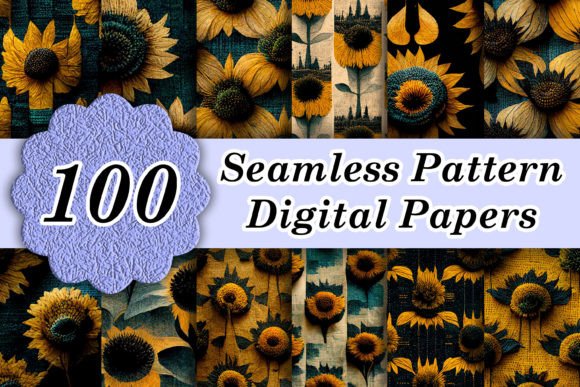
100 Sunflowers Seamless Patterns Papers
If you're designing greeting cards, scrapbook layouts, invitations, fabric mockups, or social media graphics—and especially if you love the warmth, cheer, and natural elegance of sunflowers—you’ll appreciate how much time and visual consistency a high-quality seamless pattern pack saves. The 100 Sunflowers Seamless Patterns Papers collection delivers exactly that: 100 ready-to-use, professionally crafted digital papers, each designed to tile perfectly without visible seams or repetition artifacts.
But here’s what many buyers overlook before downloading or applying them: not all “sunflower patterns” are created equal—and not all are truly optimized for real-world design work. A beautiful thumbnail doesn’t guarantee print readiness, editing flexibility, or compatibility with your workflow. Let’s clear up some common missteps—and how to avoid them.
Assuming “seamless” means “plug-and-play” in every context
Seamless doesn’t automatically mean *universal*. Some designers assume these patterns will drop into Canva, Photoshop, or Cricut Design Space without adjustment—only to find tiling glitches, color shifts, or resolution loss when scaling. Why? Because true seamlessness depends on both the pattern’s construction *and* how your software handles raster layers, blending modes, or export settings.
For example, one user tried using a sunflower pattern as a background in a printable planner cover—but printed at 8.5″ × 11″ and noticed faint lines where tiles met. The issue wasn’t the file; it was exporting from Illustrator with “Align to Pixel Grid” enabled, which subtly distorted the edges. Turning that off—and confirming the pattern was applied as a linked (not embedded) swatch—solved it instantly.
Better approach: Always test one pattern at your intended output size first. Open a single .JPG in your editor, set canvas dimensions to match your final use (e.g., 12″ × 12″ at 300 dpi), and zoom to 200% to inspect tile boundaries. If you see inconsistencies, try re-importing with “Preserve Exact Pixels” or disabling auto-resampling.
Overlooking resolution and color fidelity for print
The 100 Sunflowers Seamless Patterns Papers include 100 .JPG files—each at 3600 × 3600 pixels and 300 dpi. That’s ideal for standard 12″ × 12″ prints, photo books, or craft projects. But some users mistakenly resize them upward for large-format prints (like 24″ × 36″ posters) and wonder why details blur or petals look pixelated.
Here’s the practical truth: JPG is a lossy format. Upscaling beyond 100% degrades sharpness—even with high starting resolution. And while RGB works fine for screen use, CMYK conversion for professional printing can mute yellows and greens if the original file wasn’t soft-proofed.
What to check before printing: Confirm your printer’s preferred color space (RGB for home inkjet, CMYK for commercial print shops). If sending to a lab, convert one sample file to CMYK *before* batch-processing—and compare side-by-side with the RGB version. Adjust saturation or brightness only if needed, not as routine.
Misjudging licensing scope—and risking reuse limits
This pack is for personal *and* commercial use—meaning you can use these patterns in client work, sell physical products (like journals or mugs), or include them in digital templates you license. But it’s not an unlimited enterprise license. You may not resell or redistribute the files themselves, nor claim authorship of the patterns.
A freelance designer once bundled five sunflower patterns into a “free resource kit” for her email list—unaware that redistribution—even free—violates standard digital product licenses. She received a polite but firm notice. It wasn’t punitive, but it did require removing the files and updating her terms.
Pro tip: Read the license summary included in the .zip folder—not just the listing description. Most creators clarify permitted uses clearly. When in doubt, reach out before launching a high-stakes project.
Skipping file organization—and paying in lost time
All 100 files arrive in a single .zip folder, named numerically (Sunflower_01.jpg through Sunflower_100.jpg). That’s clean—but not intuitive if you’re searching for “vintage,” “watercolor,” or “minimalist” styles mid-project. Without preview thumbnails or descriptive filenames, you might open 12 files before finding the right texture.
One educator building a nature-themed lesson packet spent 20 minutes hunting for a muted, sketch-style pattern—only to realize later it was labeled Sunflower_73.jpg, buried under bolder, busier designs.
Better habit: On first download, extract the .zip and create subfolders by visual style: “Line Art,” “Watercolor,” “Bold Graphic,” “Subtle Texture.” Rename a few key files with descriptive tags (e.g., “Sunflower_42_watercolor-soft-yellow.jpg”). Takes 5 minutes—and saves hours over months of use.
Underestimating versatility beyond paper crafts
These aren’t just for scrapbooking. Because each file is 3600 × 3600 pixels at 300 dpi, they work beautifully as:
- Backgrounds for Zoom virtual classroom backdrops (cropped to 16:9)
- Fill layers in branding mood boards
- Textures overlaid on product photos (set to Multiply or Overlay at 15–30% opacity)
- Base layers for SVG cut files in Silhouette Studio (rasterized at full size for accurate cutting)
- Subtle website section backgrounds—when exported as WebP for faster loading
Don’t limit them to “paper” just because they’re called “papers.” Think of them as versatile surface textures—with sunflower charm built in.
Final note: Your review helps more than you think
When you leave a genuine, specific review—mentioning which patterns you used, how they performed in your project, or even a small tip you discovered—you’re helping fellow creators evaluate fit *before* purchasing. It also signals to the designer what resonates (e.g., “loved the muted tones in Sunflower_88 for wedding stationery”), guiding future releases—including those freebies and updates promised in the listing.
And yes—following for new designs is a smart move. Seasonal collections (think sunflowers + autumn leaves, or sunflowers + bees) often build on this foundation. But always verify release notes: newer packs may include PNGs with transparency, Procreate brushes, or vector versions—complements, not replacements, for this core set.
So go ahead—download, test, organize, and design. With the 100 Sunflowers Seamless Patterns Papers, you’re not just getting files. You’re getting reliable, joyful, print-ready texture—ready to support your creativity, not complicate it.