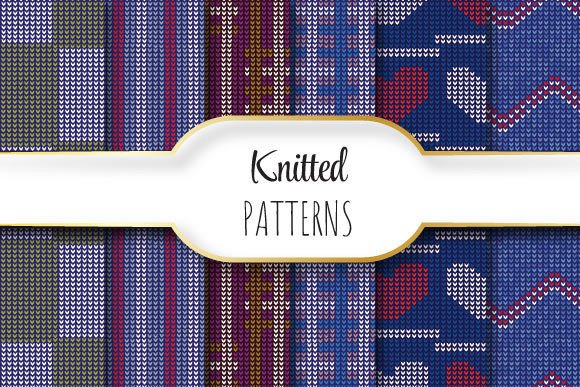
Knitted Patterns as Foundational Design Assets for Seamless Vector Repetition
Knitted Patterns—when translated into digital vector form—are far more than decorative motifs. They represent a sophisticated intersection of craft logic, mathematical repetition, and visual rhythm. Unlike arbitrary geometric tiles or algorithmically generated textures, knitted patterns encode structural intelligence: each stitch relates to its neighbors in predictable, scalable ways. This inherent consistency makes them uniquely suited for seamless vector pattern development—especially when delivered at professional-grade specifications like 12 × 12 inches (3600 × 3600 pixels, 300 dpi) in EPS 10 format.
Why Seamlessly Repeating Vector Patterns Matter Across Disciplines
Seamless repetition isn’t just about aesthetics—it’s functional infrastructure. In textile design, a misaligned tile causes visible seams on fabric rolls. In packaging, inconsistent tiling creates registration errors during print runs. In digital interfaces, non-seamless backgrounds produce distracting micro-gaps at tile boundaries. Knitted Patterns, with their built-in symmetry and interlocking logic, reduce the risk of such failures. Their origins in hand- or machine-knitting mean they’re already tested for continuity across infinite repeats—making them inherently robust starting points for vector adaptation.
Consider a fashion designer developing a limited-run scarf collection. Using a hand-drawn cable knit motif converted into a perfectly aligned vector tile ensures that when the pattern is scaled across a 200 cm length, no visual “jump” occurs at repeat boundaries. Similarly, an architectural visualization studio applying a subtle herringbone-inspired Knitted Pattern as a background texture on interior renderings benefits from pixel-perfect alignment—eliminating artifacts that would otherwise undermine photorealism.
Technical Specifications: What 12 × 12 Inches at 300 DPI Actually Enables
The 12 × 12 inch dimension (3600 × 3600 pixels at 300 dpi) is not arbitrary—it reflects real-world production thresholds. At this resolution, the pattern retains fidelity whether printed on business cards or billboard-sized banners. A 300 dpi raster output ensures sharpness for high-end offset printing, while the underlying EPS 10 vector file preserves scalability without degradation. This dual-format delivery bridges two essential needs: precision in physical output and flexibility in digital manipulation.
For example, a branding agency designing stationery for a luxury yarn brand might use the EPS file to scale the Knitted Pattern to wrap around a cylindrical pen case—maintaining crisp edges at any size. Simultaneously, the six included JPEG files (optimized at varying compression levels and color profiles) allow rapid integration into web mockups, social media templates, or client presentations—without requiring vector-editing software. One JPEG may be sRGB-optimized for screen display; another uses CMYK separation preview for prepress review. This intentional redundancy supports diverse workflows without sacrificing quality.
EPS 10: The Vector Standard That Supports Precision Editing
EPS 10 remains the gold standard for cross-application vector compatibility—not because it’s the newest, but because it’s the most reliably interpreted. Adobe Illustrator, CorelDRAW, Affinity Designer, and even legacy prepress systems recognize EPS 10’s embedded PostScript instructions without distortion. Unlike newer formats such as SVG—which can misrender complex gradients or clipping paths across browsers—EPS 10 guarantees consistent stroke behavior, accurate Bézier curve interpolation, and reliable transparency handling.
This reliability matters deeply in education. A university textiles professor using these Knitted Patterns in a digital surface design course can assign the EPS file knowing students using older lab computers won’t encounter rendering glitches. Likewise, a small-batch manufacturer importing the file into Gerber Accumark or Lectra Modaris will see identical stitch-path logic whether working in metric or imperial units—because EPS 10 preserves coordinate integrity regardless of host application.
Real-World Applications Beyond Textiles
While rooted in knitting, these patterns demonstrate surprising versatility across domains where tactile authenticity meets technical rigor:
- Product Packaging: A beverage company launching an artisanal wool-themed cider line applies a softly shaded rib-knit vector pattern as a foil-stamped background on matte kraft boxes. The seamless nature prevents visible tiling on curved surfaces, and the 300 dpi resolution ensures legibility of fine embossed details.
- Educational Materials: STEM educators use the underlying grid logic of a seed-stitch Knitted Pattern to teach modular arithmetic and tessellation principles—overlaying transparent layers to demonstrate translational symmetry, rotational equivalence, and unit-cell boundaries.
- UI/UX Design: A fintech app incorporates a low-opacity garter-stitch pattern as a subtle backdrop behind data dashboards. Because the JPEG variants include a flattened version with optimized alpha transparency, developers integrate it directly into CSS background declarations without performance penalties.
- Architectural Visualization: Interior designers apply a large-scale basket-weave Knitted Pattern to 3D-rendered acoustic wall panels. The vector origin allows precise UV mapping onto complex curved geometries in Blender or Twinmotion—something raster-only assets cannot achieve without stretching or blurring.
Workflow Integration: How Users Leverage the Zip Package Structure
The deliberate composition of the zip file—containing one EPS and six JPEGs—mirrors actual production pipelines. Designers rarely use only one asset type throughout a project. Instead, they move fluidly between stages:
- A textile developer opens the EPS in Illustrator to adjust repeat spacing for a specific fabric width, then exports a custom-sized TIFF for loom programming.
- A marketing team pulls a high-compression JPEG for email headers, then swaps to a lossless PNG variant (derived from the same source) for retina-display web banners.
- A researcher studying cultural motifs extracts path data from the EPS to analyze knot density distribution using Python-based vector analysis tools—leveraging the mathematically clean curves rather than approximated raster edges.
This modularity avoids the common pitfall of “one-size-fits-all” assets. It acknowledges that a researcher analyzing stitch frequency needs different data fidelity than a social media manager scheduling Instagram posts—and both benefit from originating from the same rigorously constructed source.
Practical Considerations When Implementing Knitted Patterns
Despite their advantages, successful implementation requires attention to context-specific constraints:
Color Mode Alignment: While the EPS file is device-independent, the JPEGs are typically provided in sRGB for broad compatibility. Users preparing for commercial print must convert JPEGs to CMYK *after* final sizing—never before—to avoid unintended hue shifts. The EPS, however, can be assigned a Pantone spot color library directly within Illustrator, preserving brand accuracy across substrates.
Scale Perception vs. Technical Scale: A 12 × 12 inch tile doesn’t dictate how large the motif appears visually. A tightly spaced moss stitch may read as a fine grain at 100% scale, while the same tile scaled to 50% produces an airy, open texture. Designers should test visual impact at intended viewing distance—e.g., a wallpaper pattern viewed from 3 meters behaves differently than a phone case motif seen at 30 cm.
Stitch Realism Boundaries: These are *vector interpretations* of knitted structures—not photorealistic simulations. They prioritize repeatability and editability over photographic detail. For applications demanding true-to-life yarn texture (e.g., product photography composites), users should layer the vector pattern with subtle noise overlays or displacement maps—using the EPS as a base guide, not a final surface.
Emerging Trends Reinforcing the Value of Structured Repetition
Three converging trends elevate the relevance of rigorously engineered Knitted Patterns:
- Sustainable Production Demands: As brands reduce physical sampling, digital-first workflows rely on assets that behave predictably across simulations—from virtual try-ons to fabric drape modeling. Seamless, high-res vector patterns minimize iteration cycles and material waste.
- AI-Augmented Design: Generative tools increasingly accept vector inputs as training anchors. A well-structured Knitted Pattern EPS provides clean, labeled path data that improves AI model accuracy when generating derivative motifs—unlike noisy raster sources that introduce interpretation errors.
- Cross-Material Translation: Advances in 3D weaving and digital embroidery require pattern logic that transfers across machines. A vector tile derived from actual knitting mathematics serves as a universal “source truth” for CNC looms, laser cutters, and robotic stitching arms alike.
In essence, these Knitted Patterns function less like static graphics and more like parametric foundations—designed not to be merely placed, but to be adapted, measured, layered, and extended. Their value lies not in ornamental novelty, but in operational reliability across contexts where precision, scalability, and cross-platform integrity are non-negotiable.